Showing posts with label john grisham. Show all posts

Friday, May 29, 2009

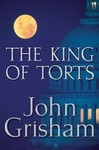
A Review: The King of Torts by John Grisham

Hardcover: 376 pages
Publisher: Doubleday Feb 2003
Language: English
ISBN-10: 0385508042
ISBN-13: 9780385508049


In my review about Grisham's The Summons, I wrote about a particular character who should have been arrested for a serious crime; I felt the fate of this character was left hanging with no closure for the reader. This character was known as the King of Torts. So when I saw this book, I thought he would probably be featured in it. I was right.

This book, however, was about the new King of Torts, J. Clay Carter II, the son of a disgraced DC lawyer, and currently working for the Office of the Public Defender. When Clay is approached by a mysterious stranger who calls himself a fireman, a freelancer who is hired by mega-corporations to put out fires, he is not prepared for what he is being offered. In this case, the corporation is multi-national pharmaceutical company. Seduced by greed and a lust for the big boy toys that millions of dollars can buy, Clay agrees to go along. The millions start pouring in and by the time Clay realizes he's in over his head, it's too late.

As you follow Clay on his roller coaster ride in the world of mass torts, you will go from liking the young dedicated lawyer and pleased that he has become successful, to not liking him at all as he becomes so obsessed with greed, fame and power that he completely loses sight of what is right.

And yes, the original King of Torts is featured, but no, he doesn't get what he deserves. Maybe in a subsequent novel.

Description (from the author's website)

The office of the public defender is not known as a training ground for bright young litigators. Clay Carter has been there too long and, like most of his colleagues, dreams of a better job in a real firm. When he reluctantly takes the case of a young man charged with a random street killing, he assumes it is just another of the many senseless murders that hit D.C. every week.

As he digs into the background of his client, Clay stumbles on a conspiracy too horrible to believe. He suddenly finds himself in the middle of a complex case against one of the largest pharmaceutical companies in the world, looking at the kind of enormous settlement that would totally change his life—that would make him, almost overnight, the legal profession’s newest king of torts…

An excerpt...

THE SHOTS THAT FIRED the bullets that entered Pumpkin’s head were heard by no less than eight people. Three instinctively closed their windows, checked their door locks, and withdrew to the safety, or at least the seclusion, of their small apartments. Two others, each with experience in such matters, ran from the vicinity as fast if not faster than the gunman himself. Another, the neighborhood recycling fanatic, was digging through some garbage in search of aluminum cans when he heard the sharp sounds of the daily skirmish, very nearby. He jumped behind a pile of cardboard boxes until the shelling stopped, then eased into the alley where he saw what was left of Pumpkin.

And two saw almost everything. They were sitting on plastic milk crates, at the corner of Georgia and Lamont in front of a liquor store, partially hidden by a parked car so that the gunman, who glanced around briefly before following Pumpkin into the alley, didn’t see them. Both would tell the police that they saw the boy with the gun reach into his pocket and pull it out; they saw the gun for sure, a small black pistol. A second later they heard the shots, though they did not actually see Pumpkin take them in the head. Another second, and the boy with the gun darted from the alley and, for some reason, ran straight in their direction. He ran bent at the waist, like a scared dog, guilty as hell. He wore red-and-yellow basketball shoes that seemed five sizes too big and slapped the pavement as he made his getaway.

When he ran by them he was still holding the gun, probably a .38, and he flinched just for a instant when he saw them and realized they had seen too much. For one terrifying second, he seemed to raise the gun as if to eliminate the witnesses, both of whom managed to flip backward from their plastic milk crates and scramble off in a mad flurry of arms and legs. Then he was gone.

Monday, May 25, 2009

A Review: The Summons by John Grisham

Hardcover: 341 pages
Language: English
Publisher: Random House Feb 2002
ISBN-10: 0385503822
ISBN-13: 9780385503822


Grisham returns to Ford County, Mississippi, the location of his novel, A Time to Kill. We visit the small town of Clanton, MS, the home of Judge Reuben Atlee. His sons, Ray who is a law professor, and Forrest, the black sheep have been summoned home to discuss the Judge's will. Ray arrives first and is greeted by his father's dead body and a hidden stash of $3,000,000. What traspires next puts Ray at physical risk as he tries to find out where the money came from. Seduced by the money, but with a conscience about keeping it, his attempts to discover the source of the money are threatened by an unknown assailant who badly wants the money.

The plot isn't a real nail biter; the characters in this book are not really all that interesting with the exception of Harry Rex, a colorful country lawyer who was the Judge's closest friend. I always looked forward to his appearance in the story. And unless Grisham carries a couple of characters over to a subsequent novel, we are left hanging about the fate of those characters.; especially one particular character who should have been apprehended and indicted for a serious crime.

It's still a book worth reading; it's just not his best.

Description (from the author's website)

Ray Atlee is a professor of law at the University of Virginia. He’s forty-three, newly single, and still enduring the aftershocks of a surprise divorce. He has a younger brother, Forrest, who redefines the notion of a family’s black sheep.

And he has a father, a very sick old man who lives alone in the ancestral home in Clanton, Mississippi. He is known to all as Judge Atlee, a beloved and powerful official who has towered over local law and politics for forty years. No longer on the bench, the Judge has withdrawn to the Atlee mansion and become a recluse.

With the end in sight, Judge Atlee issues a summons for both sons to return home to Clanton, to discuss the details of his estate. It is typed by the Judge himself, on his handsome old stationery, and gives the date and time for Ray and Forrest to appear in his study.

Ray reluctantly heads south, to his hometown, to the place where he grew up, which he prefers now to avoid. But the family meeting does not take place. The Judge dies too soon, and in doing so leaves behind a shocking secret known only to Ray.

And perhaps someone else.


An excerpt:

It came by mail, regular postage, the old-fashioned way since the Judge was almost eighty and distrusted modern devices. Forget e-mail and even faxes. He didn’t use an answering machine and had never been fond of the telephone. He pecked out his letters with both index fingers, one feeble key at a time, hunched over his old Underwood manual on a rolltop desk under the portrait of Nathan Bedford Forrest. The Judge’s grandfather had fought with Forrest at Shiloh and throughout the Deep South, and to him no figure in history was more revered. For thirty-two years, the Judge had quietly refused to hold court on July 13, Forrest’s birthday.

It came with another letter, a magazine, and two invoices, and was routinely placed in the law school mailbox of Professor Ray Atlee. He recognized it immediately since such envelopes had been a part of his life for as long as he could remember. It was from his father, a man he too called the Judge.

Professor Atlee studied the envelope, uncertain whether he should open it right there or wait a moment. Good news or bad, he never knew with the Judge, though the old man was dying and good news had been rare. It was thin and appeared to contain only one sheet of paper; nothing unusual about that. The Judge was frugal with the written word, though he’d once been known for his windy lectures from the bench.

It was a business letter, that much was certain. The Judge was not one for small talk, hated gossip and idle chitchat, whether written or spoken. Ice tea with him on the porch would be a refighting of the Civil War, probably at Shiloh, where he would once again lay all blame for the Confederate defeat at the shiny, untouched boots of General Pierre G. T. Beauregard, a man he would hate even in heaven, if by chance they met there.

He’d be dead soon. Seventy-nine years old with cancer in his stomach. He was overweight, a diabetic, a heavy pipe smoker, had a bad heart that had survived three attacks, and a host of lesser ailments that had tormented him for twenty years and were now finally closing in for the kill. The pain was constant. During their last phone call three weeks earlier, a call initiated by Ray because the Judge thought long distance was a rip-off, the old man sounded weak and strained. They had talked for less than two minutes.

The return address was gold-embossed: Chancellor Reuben V. Atlee, 25th Chancery District, Ford County Courthouse, Clanton, Mississippi. Ray slid the envelope into the magazine and began walking. Judge Atlee no longer held the office of chancellor. The voters had retired him nine years earlier, a bitter defeat from which he would never recover. Thirty-two years of diligent service to his people, and they tossed him out in favor of a younger man with radio and television ads. The Judge had refused to campaign. He claimed he had too much work to do, and, more important, the people knew him well and if they wanted to reelect him then they would do so. His strategy had seemed arrogant to many. He carried Ford County but got shellacked in the other five.

It took three years to get him out of the courthouse. His office on the second floor had survived a fire and had missed two renovations. The Judge had not allowed them to touch it with paint or hammers. When the county supervisors finally convinced him that he had to leave or be evicted, he boxed up three decades’ worth of useless files and notes and dusty old books and took them home and stacked them in his study. When the study was full, he lined them down the hallways into the dining room and even the foyer.